





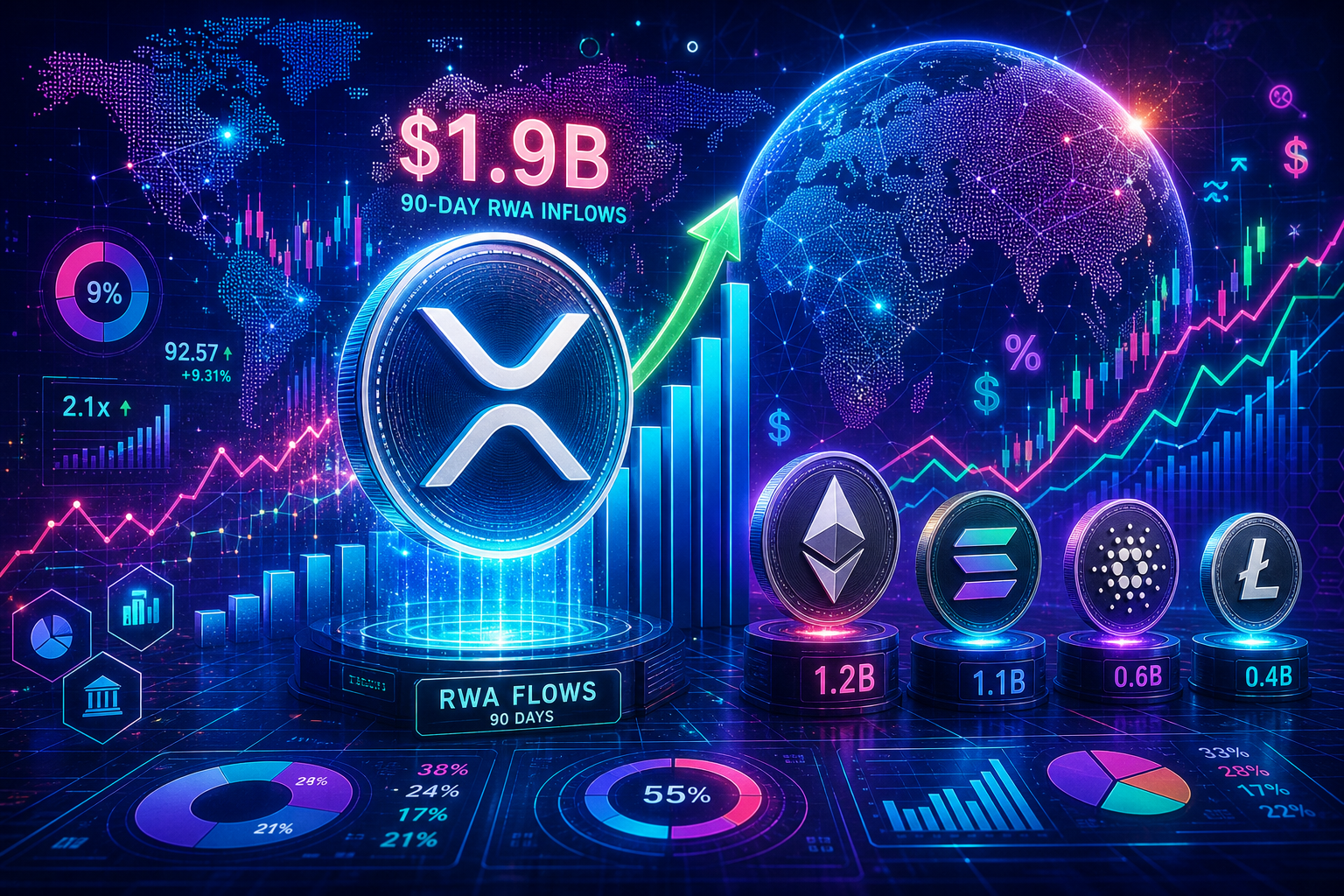
In the ever-evolving world of cryptocurrencies, the competition among blockchain platforms continues to intensify. Recent data shows that the XRP Ledger (XRPL) has emerged as a surprising leader in attracting real-world asset (RWA) inflows, surpassing major platforms such as Ethereum and Solana. This article delves into the implications of this development, the context surrounding it, and what it means for the future of XRP and the broader crypto market.
XRP's Impressive Inflows: A Quick Overview
Over the past 90 days, XRPL has recorded an astonishing $1.9 billion in net inflows of tokenized real-world assets. This figure outstrips the inflows seen by Ethereum, which managed to attract $1.6 billion, and Stellar, with $1.4 billion. Other notable players, such as BNB Chain, Solana, Avalanche, Sei Network, and Mantle, trailed significantly behind, with inflows ranging from $848 million to $90 million.
While XRP's recent performance is impressive, it is essential to understand that this does not mean it has dethroned Ethereum as the leader in the overall tokenized asset value. Ethereum still commands a 52.8% share of the tokenized asset market, translating to approximately $17 billion in total tokenized asset value. Nonetheless, the recent surge in XRP's RWA inflows underscores a shifting competitive dynamic among Layer 1 networks as they vie for institutional capital.
The Growing Market for Tokenized Real-World Assets
The rise of tokenized real-world assets is a noteworthy development in the financial landscape. Tokenized RWAs encompass a wide range of financial instruments, including digitized sovereign debt, private credit, and multi-asset funds. According to data from the platform RWA.xyz, the global market for distributed asset value has skyrocketed to $33.5 billion, with a broader representation of $350 billion in total asset value.
As the demand for tokenized assets continues to grow, the competitive landscape is shifting. While Ethereum has historically been the go-to platform for tokenized assets, its rate of expansion is now being challenged by alternative blockchains like XRPL. For instance, Ethereum's asset base grew by approximately 35% throughout 2026, which, while substantial, is being outpaced by the XRP Ledger on a relative basis in the short term.
XRPL's Unique Growth Trajectory
According to a recent analysis from institutional treasury firm Evernorth, XRPL's growth trajectory places it among the top-tier legacy networks in terms of attracting institutional capital. Analysts at Evernorth noted that the inflows onto XRPL are characterized by substantial, treasury-scale commitments rather than fragmented retail transactions. This distinct pattern aligns more closely with institutional deployment behavior, where financial entities prefer to execute large programmatic bond and fund originations in single tranches rather than engaging in gradual market accumulation.
This structured approach to capital inflows is significant for the XRPL, as it demonstrates a growing institutional interest in utilizing blockchain technology for managing real-world assets. As commercial banking institutions and asset managers increasingly explore the structural efficiency of tokenized fixed-income securities and fund products, XRPL’s architecture becomes a critical factor in facilitating these transactions.
Understanding XRPL’s RWA Footprint
To accurately measure network activity within the RWA sector, it is crucial to distinguish between various accounting layers on the XRPL. The platform segments its activity into two specific layers: distributed asset value and represented asset value. Currently, the total tokenized assets represented on XRPL approximate $3.6 billion, which tracks financial assets for compliance and structural representation. In contrast, the active distributed asset value, which refers to assets natively settled and circulating within decentralized protocols, stands at $360.25 million.
This multi-layered structure allows institutions to test the operational efficiency of their tokenized assets. However, it heavily relies on robust underlying stablecoin liquidity to facilitate efficient settlement of these transactional flows. Recent on-chain metrics indicate a notable expansion of this settlement infrastructure. For instance, the stablecoin market capitalization on XRPL reached $907.63 million, reflecting a 73.44% increase over a rolling 30-day period. Concurrently, the transactional velocity of stablecoins has surged, with 30-day stablecoin transfer volumes rising 90.90% to settle at $4.86 billion.
The Role of Ripple and Institutional Engagement
Ripple, the company behind XRPL, has made significant strides in adjusting its infrastructure to accommodate institutional activity. The firm has been actively advancing payment rails through corporate integrations while enhancing operational settlement mechanics related to its RLUSD stablecoin. This adaptability positions Ripple favorably in the competitive landscape of blockchain platforms, allowing it to attract larger institutional players.
A Shifting Trading Landscape: Upbit's Dominance
Alongside the influx of institutional capital into XRPL, a notable shift in trading activity has also emerged. Data from CryptoSlate indicates that XRP has seen a price increase of more than 5% in a 24-hour period, reaching intraday highs of $1.29 before settling around $1.24. This price surge coincides with a broader upswing in the crypto market, attributed in part to geopolitical developments such as the peace deal between the U.S. and Iran.
However, a deeper analysis reveals that the capital flows driving this market structure are unevenly distributed across different geographical regions. Specifically, data from CryptoQuant shows a significant concentration of wallet-flow activity within South Korea, particularly on Upbit, the country’s largest digital asset exchange. Upbit's share of global XRP wallet-flow dominance surged from 13% on June 7 to 31% by June 14, marking its highest concentration of network interaction since May 2024.
In contrast, Western platforms have experienced a decline in wallet-flow dominance during the same period. For instance, Coinbase's share plummeted from 27% on May 7 to virtually 0% by June 14. Similarly, Binance's dominance decreased from 16% to 13%, while Crypto.com saw its share contract from 9% to 3%.
This geographic divergence indicates that the ongoing market participation is primarily driven by concentrated capital rotation within East Asian trading venues, rather than a widespread retail resurgence across U.S. or European platforms.
The Derivatives Market: A Cautious Rebound
The trends observed in the spot market are mirrored in the cryptocurrency derivatives market, where open interest metrics suggest a disciplined rebuilding of risk positions. On Binance, the primary venue for digital asset futures, the 30-day rolling average for XRP open interest has risen to its highest level in over four months. This increase, which reached approximately 486.8 million XRP, signifies a methodical return of positions rather than speculative spikes.
Further analysis of the positioning within the derivatives market indicates a balanced market structure. The XRP Open Interest Z-Score, which measures the deviation from historical norms, registered at 0.19. This suggests that the expansion in open interest is the result of gradual accumulation of both directional and hedging positions, rather than excessive unhedged leverage. Such a measured buildup indicates that market participants are preparing for potential structural volatility, rather than immediate speculative liquidations.
Conclusion: A Fragile, Yet Promising Future for XRP
XRP's recent performance in attracting RWA inflows and its positioning within the broader crypto ecosystem reveal a complex and evolving landscape. While the surge in RWA inflows presents a compelling case for XRP's growth and institutional interest, the trend remains fragile and concentrated in specific markets. The dominance of trading activity in South Korea and the cautious rebound in the derivatives market underline the need for a balanced perspective when evaluating XRP's future prospects.
As the competition among blockchain platforms intensifies, XRP's ability to sustain its momentum will depend on various factors, including its capacity to attract institutional capital, adapt to market dynamics, and navigate the challenges associated with global trading trends. For investors and enthusiasts alike, the coming months will be pivotal in determining whether XRP can solidify its position as a leading player in the rapidly changing world of cryptocurrencies.








No comments yet. Be the first to share your thoughts!