




Introduction: A Controversial Stance on Climate Change
In a world increasingly concerned about climate change, few figures have been as polarizing as former President Donald Trump. Throughout his presidency, he often downplayed the severity of climate issues, labeling them as hoaxes and criticizing renewable energy initiatives. However, during the first year of his second term, he took an unexpected turn, launching an investigation into Brazil’s deforestation practices, which could lead to new tariffs on Brazilian imports.
Background: The Amazon Rainforest and Its Global Significance
The Amazon rainforest is often referred to as the "lungs of the Earth," absorbing vast amounts of carbon dioxide and playing a crucial role in regulating the planet's climate. Spanning over 2 million square miles across nine countries, it serves not only as a vital ecosystem but also as a carbon sink that mitigates the impacts of global warming. Brazil houses approximately 60% of this irreplaceable resource. Unfortunately, the country has faced rampant deforestation, primarily driven by agriculture, particularly cattle ranching, and soy production.
In recent years, legal deforestation has cost Brazil about 3.7 million acres of rainforest annually. This not only threatens biodiversity but contributes significantly to greenhouse gas emissions — a fact that is crucial in the ongoing battle against climate change.
Trump's Tariff Strategy: A Closer Look
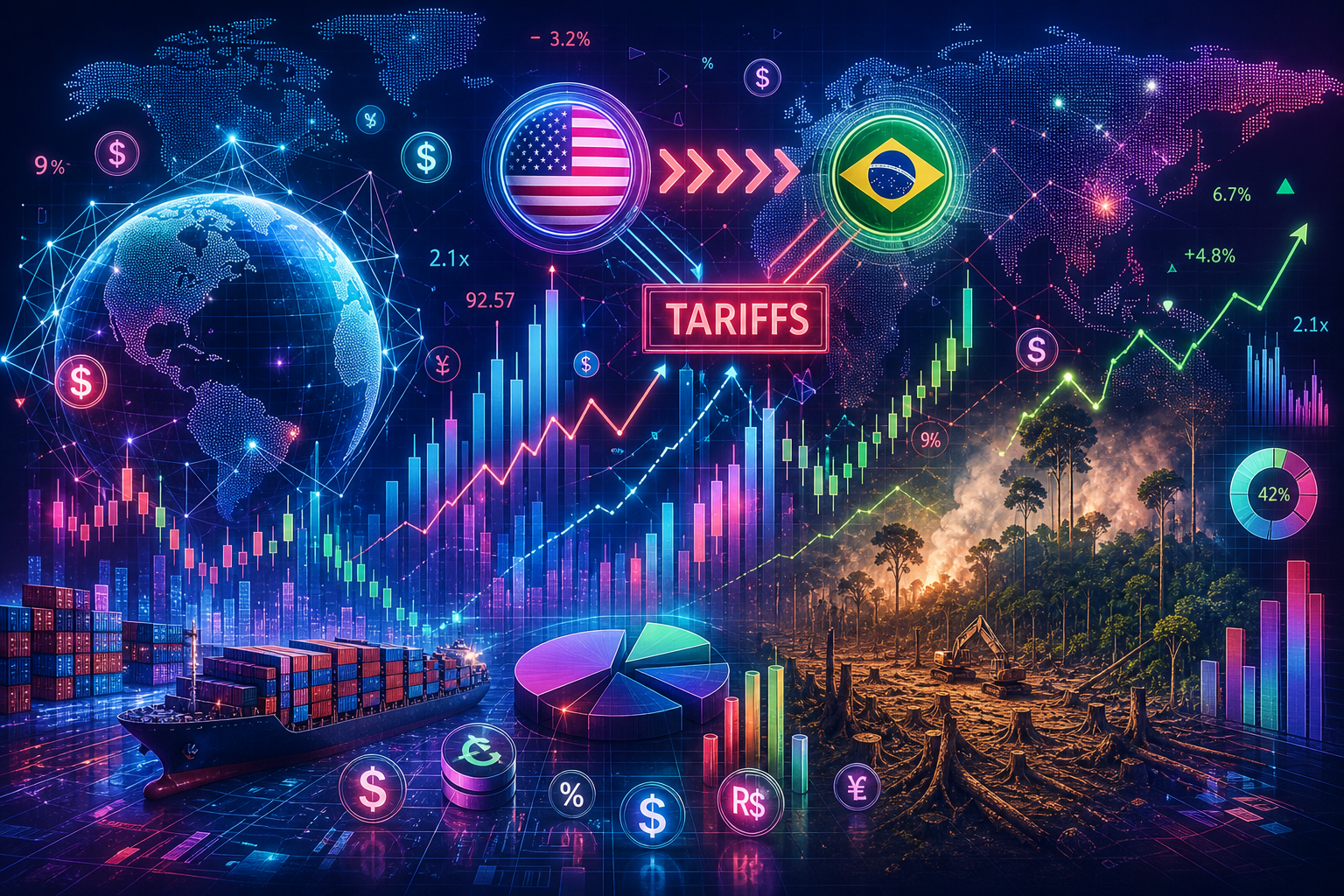
In a September 2025 speech at the United Nations, President Trump dismissed carbon footprints as a "hoax" and derided wind energy. Yet, in a curious about-face, his administration initiated a probe into Brazil's deforestation practices under the auspices of new tariffs. The U.S. Trade Representative (USTR) accused Brazil of violating trade agreements by allowing illegal logging and land-clearing, practices that often exploit forced labor.
The tariffs in question include a 12.5% import tax on Brazil, which is framed as an effort to ensure fair trade practices. This move comes amidst heightened scrutiny of global supply chains, where products derived from deforestation and unethical labor practices can flood markets at artificially low costs. The USTR's actions suggest an intention to hold Brazil accountable for its environmental policies, albeit without explicitly linking these tariffs to climate change.
The Legal Framework: Tariffs Under Section 301
The tariffs imposed on Brazil are executed under Section 301 of the 1974 Trade Act, which allows the U.S. to take action against foreign trade practices deemed harmful to American interests. This includes investigations into trade practices that undermine fair competition, such as the use of forced labor or environmental degradation.
The recent tariffs follow legal challenges to Trump's previous tariff strategies, particularly after the Supreme Court struck down tariffs imposed under the International Emergency Economic Powers Act. As the administration seeks to maintain its trade policy's cornerstone, it has turned to Section 301 as a more palatable alternative that still allows for significant levies against trading partners.
The Political Landscape: Tariffs and Midterm Elections
As the 2026 midterm elections approach, the political implications of these tariffs cannot be understated. Trump's tariff strategy has faced backlash from various quarters, including U.S. companies and consumers who are critical of increasing import costs. Many importers are currently pursuing refunds for tariffs imposed over the past year, raising questions about the overall effectiveness of this approach.
Experts, like Georgetown University's Marc Busch, suggest that framing these tariffs around ethical issues, such as deforestation and human rights, might resonate more with voters, especially Democrats who have consistently pushed against environmental degradation. The question remains: Can Trump effectively leverage this issue to bolster his narrative of affordability leading into the elections?
The Irony of U.S. Policy: A Contradiction in Stance
One of the most striking aspects of this situation is the irony of the U.S. criticizing Brazil for deforestation while simultaneously opposing stricter environmental regulations, such as the European Union's Deforestation Regulation (EUDR). The EUDR requires companies to demonstrate that their commodities do not originate from deforested land, a policy that the U.S. and Brazil have historically contested, arguing that it imposes burdensome auditing requirements and undermines market competitiveness.
By imposing tariffs on Brazil for illegal deforestation, the U.S. contradicts its previous stance against stringent deforestation regulations, effectively adopting a policy it has historically opposed. This inconsistency raises questions about the underlying motives driving Trump's trade policy and whether they are truly rooted in environmental concerns or political expediency.
The Broader Implications: Trade and Environmental Policy
The ramifications of these tariffs extend beyond U.S.-Brazil relations; they highlight the complex interplay between trade policy and environmental stewardship. The Amazon rainforest's degradation poses significant risks not only to biodiversity but also to global climate stability. As nations grapple with the effects of climate change, the need for coherent and consistent environmental policies becomes ever more critical.
Moreover, the U.S. trade relationship with Brazil, which has shifted dramatically since the election of President Luiz Inácio Lula da Silva, adds another layer of complexity. Lula's government has expressed resistance to U.S. trade investigations, particularly those linked to environmental practices. This friction could lead to further tensions and complicate efforts to address global climate issues collaboratively.
Real-World Examples: The Impact of Deforestation
To understand the real-world implications of deforestation in Brazil, one need only look at the consequences of recent agricultural practices. The Amazon has been systematically cleared for cattle ranching, leading to significant increases in greenhouse gas emissions. According to the Brazilian National Institute for Space Research, deforestation rates surged by 9.5% in 2020 compared to the previous year, driven largely by agricultural expansion.
As companies and governments around the world wrestle with the realities of climate change, the consequences of deforestation in Brazil serve as a cautionary tale. The U.S. decision to impose tariffs may be an attempt to curb these practices, but without a concerted global effort to address the root causes of deforestation, such measures may ultimately fall short.
Conclusion: The Future of U.S.-Brazil Relations and Climate Policy
As President Trump navigates the complexities of international trade and environmental responsibility, the world watches closely. The implementation of tariffs on Brazil over deforestation raises critical questions about the sincerity of U.S. climate policy and the effectiveness of trade measures as a tool for environmental protection.
While the administration's actions may reflect a newfound concern for environmental issues, they also illuminate the contradictions inherent in U.S. policy. Moving forward, the challenge will be to align economic interests with genuine environmental stewardship, fostering a cooperative approach to one of the most pressing issues of our time: climate change.
In a global landscape increasingly characterized by fragmentation and discord, the hope remains that nations can find common ground to protect our planet for future generations. As the U.S. and Brazil navigate their complicated relationship, the stakes of these trade policies extend far beyond tariffs, reaching into the heart of global environmental sustainability.








No comments yet. Be the first to share your thoughts!