




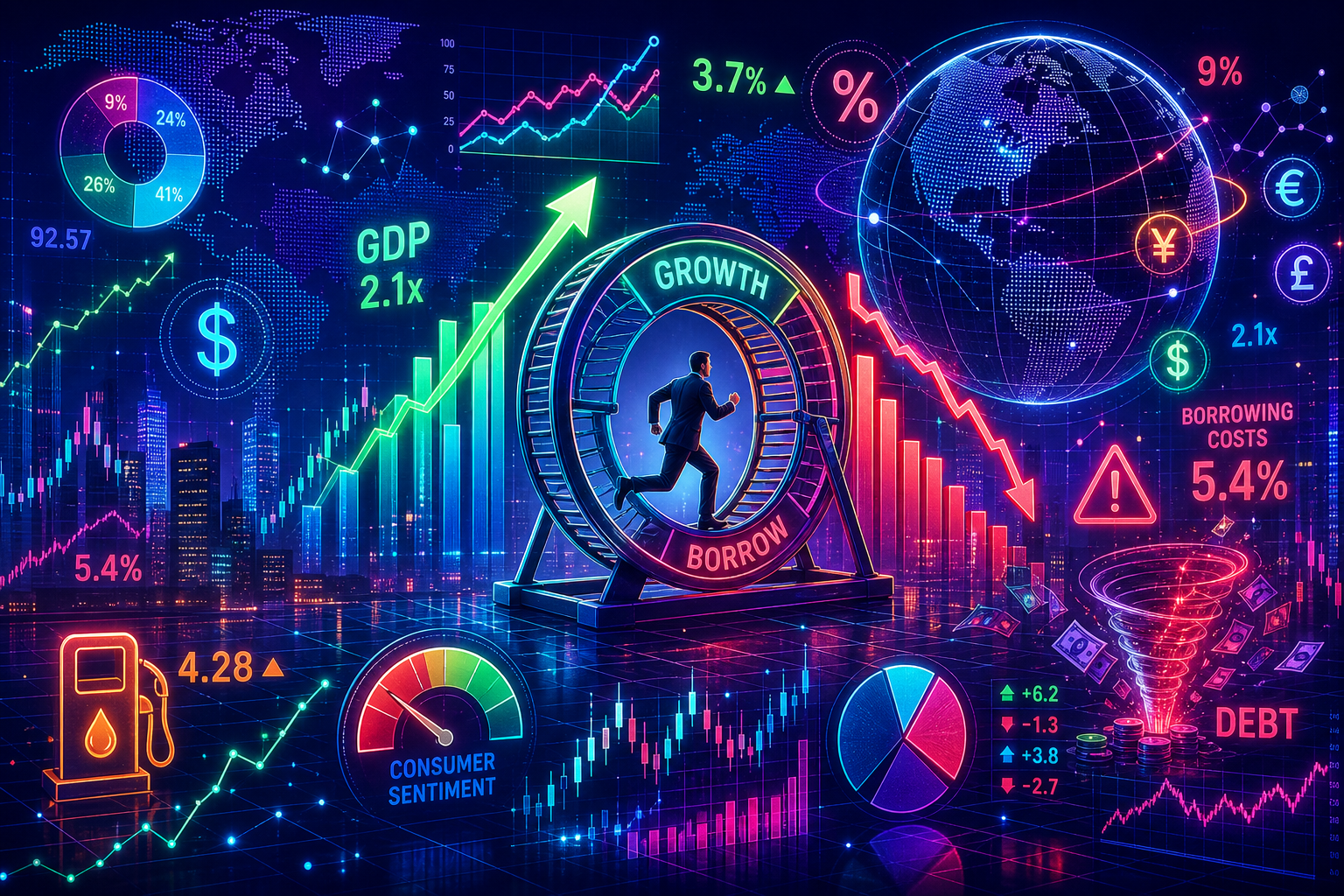
The U.S. economy is currently navigating a complex landscape marked by both assertive growth and significant risks. Despite high gas prices and a generally pessimistic consumer sentiment over the cost of living, recent indicators reveal a robust economic performance that has caught the attention of policymakers and investors alike. However, as interest rates surge and inflation remains a persistent concern, the question looms: can this growth continue, or is the economy headed toward a perilous debt spiral?
A Resilient Economy in Uncertain Times
The U.S. economy has demonstrated a remarkable ability to absorb shocks—whether from President Donald Trump’s tariffs or geopolitical tensions such as the ongoing conflict with Iran. Recently, the Federal Reserve took decisive action by raising interest rates, acknowledging that the economy is not only resilient but thriving. This move aims to curb inflation, which has become increasingly pressing as the economy operates at capacity.
Currently, the gross domestic product (GDP) growth is outpacing the rising costs of borrowing. While inflation-adjusted growth hovers around 2%, nominal growth has soared above 6%. This has kept the GDP ahead of interest rates, which have recently spiked, particularly the 10-year Treasury yield, reaching levels above 5.16%. This dynamic creates a precarious balance, as the economy must continue sprinting to avoid a situation where debt grows at a faster rate than economic output.
The AI Boom: A Driving Force
One of the most significant catalysts for economic growth has been the surge in investments related to artificial intelligence (AI). Major tech companies—including Alphabet, Amazon, Microsoft, Meta, Oracle, and SpaceX—are projected to invest a staggering $870 billion in capital expenditures this year alone, up from $470 billion just a few years ago. By 2027, spending from these “hyperscalers” is expected to exceed $1.3 trillion, indicating that the AI build-out could surpass historical booms, such as the railroad expansion of the 19th century, according to economist Stijn van Nieuwerburgh.
This influx of capital is not confined to the tech sector; it is spilling over into traditional industries, benefitting longstanding players like Caterpillar and General Electric. UBS economist Jonathan Pingle noted that the extensive demand created by AI investments is generating a ripple effect, boosting capital expenditures across various sectors. This widespread investment suggests a robust economic environment, yet the sustainability of this growth remains questionable.
Government Spending and Debt Concerns
Adding to the economic complexities is the federal government’s staggering budget deficit, currently estimated at $2 trillion annually. Much of this deficit is financed through debt, with the proceeds flowing into consumer spending, largely through entitlement programs. This creates a cyclical effect where government spending boosts corporate profits and stock valuations.
However, analysts are increasingly concerned about the sustainability of this growth trajectory. As borrowing costs rise, the ability of the economy to outpace debt becomes more tenuous. Some Wall Street experts have issued warnings about the potential for an AI bubble, suggesting that the rapid growth in this sector may not last. Instances of AI misbehavior and ethical concerns have sparked calls for more cautious development, which could lead to a slowdown in investment.
The Tipping Point: Interest Rates and Economic Growth
Rockefeller International Chairman Ruchir Sharma has posited that the AI bubble could burst if the 10-year Treasury yield decisively surpasses 5%. This would signal a transition into a "new era of tighter money," making it increasingly difficult to fund large-scale AI projects. Notably, as nominal GDP growth hovers around 4%, the risk of entering a debt spiral becomes more pronounced, with the Committee for a Responsible Federal Budget (CRFB) sounding alarms about the trajectory of U.S. debt.
According to the CRFB, with interest rates on new Treasury bonds around 5%, and economic growth expectations set lower, the U.S. could be facing a fiscal crisis that may lead to higher unemployment, crashing asset values, and cuts in government support. The interplay of these factors suggests that a slowdown in economic growth may not necessarily translate into lower bond yields, which have been rising due to competition for capital among heavily indebted nations and corporations.
Geopolitical Risks and Market Dynamics
Another layer of complexity in this equation is the geopolitical landscape. Ongoing conflicts, trade tensions, and environmental disasters have created an environment of uncertainty that investors are increasingly pricing into bond yields. This perceived instability can lead to higher yields, as investors demand more attractive returns to compensate for the risks involved.
Furthermore, the Federal Reserve's stance on inflation remains a wild card. While recent hawkish moves by Chairman Kevin Warsh have provided some credibility, the market remains sensitive to shifts in Fed policy. If the central bank fails to control inflation effectively, it may trigger a reevaluation of the favorable economic conditions currently enjoyed.
Conclusion: Navigating the Future
As the U.S. economy continues to grow, the key challenge remains the delicate balance between maintaining growth and managing rising debt levels. The investment boom in AI presents both opportunities and risks, and the potential for a bubble to burst could have far-reaching implications for the broader economy. Policymakers, investors, and consumers alike must remain vigilant as they navigate this complex economic landscape.
With rising interest rates, a potentially cooling economy, and a host of geopolitical uncertainties, the path forward is fraught with challenges. The resilience of the U.S. economy will be tested in the coming months, and how it adapts to these pressures will determine whether it can sustain its growth momentum or succumb to a debt spiral. As we look ahead, a balanced perspective will be essential in assessing both the opportunities and risks that lie ahead for the U.S. economy.








No comments yet. Be the first to share your thoughts!