




Introduction: A Bold Vision in the Making
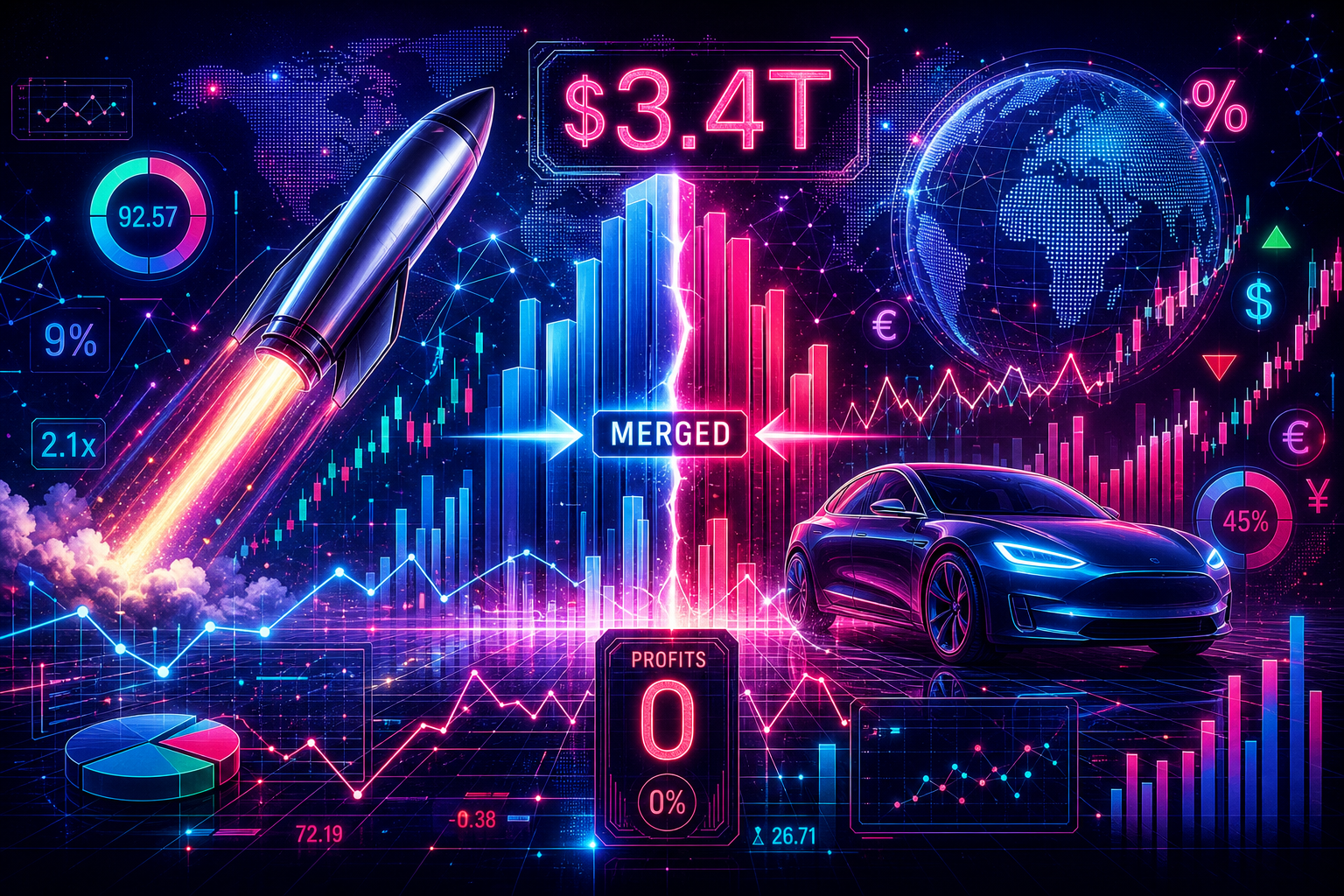
On May 27, 2023, CNBC reported that Tesla and SpaceX, two of Elon Musk's most ambitious ventures, are considering a merger. This news has ignited a whirlwind of speculation among investors and analysts alike. The prospect of combining these two titans of technology could create a corporate behemoth valued at an astounding $3.4 trillion. However, while the potential is vast, the financial realities present a sobering counterpoint.
Context: The Players in the Game
Tesla is renowned for revolutionizing the electric vehicle (EV) market, achieving a significant share in global automotive sales. Despite facing challenges, including increasing competition and fluctuating profitability, Tesla remains a key player in the transition to sustainable energy.
SpaceX, on the other hand, has redefined the aerospace industry with its ambitious goals of colonizing Mars and providing internet access through its satellite constellation, Starlink. The company’s valuation has soared, with expectations surrounding its upcoming IPO suggesting a market cap of $1.75 trillion.
The Merger Speculation: Is It Likely?
Wedbush Securities analyst Dan Ives has placed the probability of a merger at 80%, indicating that plans for such a union could already be in motion. Long-time Tesla investor Ross Gerber has pointed out that Musk's recent moves, including folding his AI venture xAI into SpaceX, suggest a deliberate strategy to streamline operations and enhance the overall value proposition of his companies.
Currently, betting site Kalshi reports a 52% likelihood that a merger will occur by May 2024. But what would the implications of such a union be?
Financial Dynamics: Valuation vs. Profitability
The combined entity of SpaceX and Tesla would boast a staggering valuation of $3.4 trillion, making it one of the most valuable companies in the world. However, both firms face significant financial hurdles.
Tesla's Profitability Woes
In the most recent financial year, Tesla reported $3.9 billion in GAAP net earnings, a sharp decline from $15 billion in 2022. This figure is also inflated by revenue from regulatory credits, which are expected to diminish over time. If we focus on core earnings, Tesla's actual profitability sits around $2.3 billion.
SpaceX's Financial Picture
In contrast, SpaceX recorded a loss of $4.94 billion last year, with its Starlink division generating some profit but the space exploration side facing substantial deficits. AI investments have compounded these losses, with operating expenses related to AI reaching nearly $9 billion over the last five quarters.
If we consider the combined financials of a merged entity, we would see a pro-forma GAAP earnings figure of approximately -$1 billion, highlighting the precarious financial standing of both companies.
The Capital Expenditure Challenge
One of the most pressing concerns surrounding a potential merger involves the capital expenditures (capex) both companies are facing. SpaceX anticipates significant outlays to establish its AI data centers, while Tesla is ramping up its investments in production capabilities and autonomous technology.
Tesla's capex is projected to exceed $22.5 billion over the next nine months, overshadowing the cash flow generated from its core operations. This rising need for capital means that both firms could struggle to fund their ambitious projects without resorting to issuing additional shares or increasing debt — strategies that could dilute shareholder value and burden both companies financially.
The Interconnectedness of SpaceX and Tesla
Despite their individual challenges, SpaceX and Tesla have been increasingly interconnected. Tesla has invested $2 billion in xAI, a move that reinforces their collaboration. Additionally, SpaceX's procurement of over $700 million in battery storage systems from Tesla exemplifies their mutual reliance.
The rationale behind a merger is clear: both companies aim to harness the AI revolution, which analysts estimate could reach a total addressable market of $26.5 trillion. However, they would face intense competition from established tech giants like Amazon and Google, which threaten to erode profit margins.
The Risks of Overvaluation
While a merger would create a corporate giant, the valuation raises critical questions. With SpaceX's market cap at $1.75 trillion and Tesla's at $1.65 trillion, the merger would result in a staggering price-to-earnings ratio of 420 for SpaceX's shareholders, translating to a mere $2.30 in earnings for every $1,000 invested.
David Trainer, CEO of New Constructs, argues that the financial metrics required for success are virtually unattainable. He estimates that to meet cost-of-capital returns, the merged entity would need to achieve $248 billion in net income and $1.1 trillion in revenue by 2035 — figures that are not only ambitious but also unprecedented in the current corporate landscape.
The Potential Outcomes: A Double-Edged Sword
The merger could theoretically serve to stabilize Tesla's wavering stock price by allowing SpaceX to acquire the company at an inflated valuation. However, this strategy would merely transfer the financial burdens from Tesla to SpaceX. Musk's ambitious vision requires achieving extraordinary feats, and the risks associated with this merger might lead even the staunchest supporters to reconsider their positions.
Conclusion: A Visionary or a Risky Gamble?
As discussions of a SpaceX-Tesla merger evolve, the implications for shareholders, employees, and the broader market cannot be overstated. While the potential for growth is undeniable, the financial realities present a formidable obstacle.
Both companies must navigate an increasingly complex landscape characterized by high capital demands, competitive pressures, and the necessity to deliver tangible returns to investors. In the pursuit of greatness, Elon Musk's vision of merging these two pioneering companies will test the limits of innovation and investor faith like never before.
In the end, the question remains: will this merger usher in a new era of technological advancement, or will it expose the fragility of valuations built on ambition rather than solid financial foundations? As investors and analysts watch closely, the outcome of this potential union could redefine the future of the tech landscape.








No comments yet. Be the first to share your thoughts!