





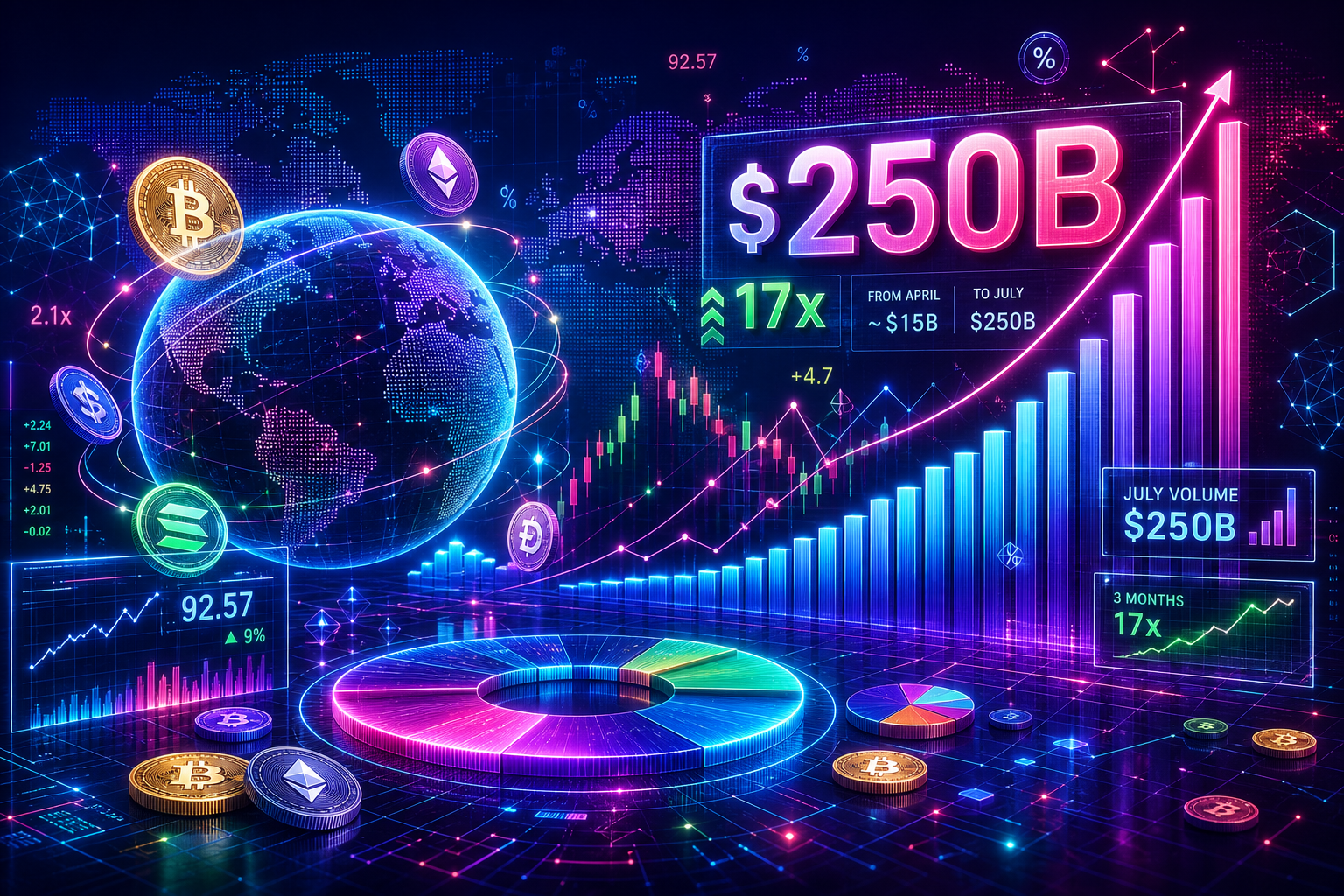
The landscape of cryptocurrency trading is undergoing a significant transformation, as evidenced by a recent surge in equity perpetual futures volume. In July, this market reached an astonishing $250 billion, marking a 17-fold increase from a mere $15 billion in April. This rapid expansion, highlighted by analytics firm CryptoQuant, underscores the growing interest in equity-linked products on digital asset exchanges and signals a broader shift in the finance landscape.
The Rise of Equity Perpetual Futures
Equity perpetual futures allow traders to gain exposure to traditional stock markets without the constraints of conventional trading hours. Unlike traditional equity trading, which is subject to market opening and closing times, these perpetual contracts provide continuous access to stocks. This flexibility is particularly appealing to traders looking to capitalize on market movements at any time of the day.
The surge in equity perpetual futures volume reflects a burgeoning market that is not just confined to cryptocurrencies like Bitcoin or Ethereum. Instead, it has expanded to encompass various sectors, notably technology and semiconductors, which have become the focal point of trading activity.
Binance: The Dominant Player
Leading the charge in this new trading environment is Binance, which accounted for approximately $193 billion of the total equity perpetual futures volume in July. This figure represents about 76% of the entire market, showcasing Binance's dominance in this space. Following Binance, other exchanges like Bitfer, Bybit, and Gate are also participating, albeit at a significant distance.
Gate, in particular, has emerged as the fastest-growing venue, with its equity perpetual futures volume soaring by 308% from June. This growth trajectory has been consistent, as Gate has recorded increased trading volumes for several consecutive months. Meanwhile, Bybit and Binance saw increases of 176% and 59%, respectively.
The AI-Memory Complex
A deeper analysis reveals that the trading activity in these perpetual futures is heavily concentrated in a limited number of assets, primarily associated with the AI-memory complex. Stocks such as SanDisk, SK Hynix, and Micron, along with the leveraged semiconductor ETF SOXL, have dominated trading volumes. In fact, on Gate alone, SanDisk and SK Hynix comprised a staggering 53% of the exchange’s total equity perpetual futures volume in July.
This concentration raises questions about the sustainability of such a narrow focus on specific assets. While it may offer lucrative opportunities for traders willing to engage with these stocks, it also exposes them to concentrated risks should market dynamics shift.
A Broader Shift in Digital Asset Exchanges
The rise of equity perpetual futures signifies a broader evolution in how digital asset exchanges operate. Traditionally, these platforms were primarily dedicated to trading cryptocurrencies. Now, they are diversifying their offerings to include traditional financial instruments, reflecting an evolving landscape in which crypto-native capital is increasingly attracted to equity-linked products.
By enabling access to these perpetual contracts, exchanges are not just catering to the cryptocurrency community but are also providing tools for traditional investors looking to explore digital finance. This hybrid approach allows investors to engage with stocks while benefiting from the continuous trading structure characteristic of crypto markets.
Implications for the Future
While the rapid growth of equity perpetual futures is promising, it raises important questions about the market's future. Will the current concentration in specific stocks persist, or will we see a diversification of trading activity across a broader range of equity perpetual contracts?
CryptoQuant's report suggests that the market has expanded quickly, but its future trajectory may depend on various factors, including regulatory developments, technological advancements, and shifts in investor sentiment. As more traders become aware of the opportunities in equity-linked crypto products, we may witness a significant evolution in trading behavior.
The Role of Regulation and Technology
The regulatory landscape will play a crucial role in shaping the future of equity perpetual trading on crypto exchanges. As governments and regulatory bodies continue to develop frameworks for digital assets, the clarity provided could either encourage growth or impose restrictions that might stifle innovation.
Moreover, advancements in technology will further enhance trading capabilities. Improved algorithms, better user interfaces, and better risk management tools can attract a wider array of investors to equity perpetual contracts.
Real-World Examples and Market Considerations
To illustrate the implications of this shift, let's consider the case of micro-investing platforms, which have gained traction by allowing consumers to invest small amounts in stocks. The emergence of equity perpetual futures on crypto exchanges operates on a similar principle, democratizing access to traditional markets.
For instance, platforms like Robinhood and WeBull have shown immense success by lowering the entry barriers for stock trading. Similarly, if crypto exchanges can provide intuitive trading experiences for equity perpetual futures, they may attract retail investors looking to diversify their portfolios.
Conclusion: A New Era for Crypto and Traditional Finance
The explosive growth of equity perpetual futures on digital asset exchanges marks a significant turning point in both the crypto and traditional finance landscapes. As these platforms continue to evolve, they will likely play an increasingly important role in the financial ecosystem, bridging the gap between two worlds that were once largely separate.
Investors and traders alike should remain vigilant as this market develops. While opportunities abound, so do risks, particularly in terms of asset concentration. By staying informed and adaptable, participants in this burgeoning market can navigate the complexities and seize the potential that equity perpetual futures have to offer.
In the coming months, as the market continues to mature and broaden its offerings, we may well see a new standard for trading that integrates the best of both worlds—traditional and digital finance. The journey is just beginning, and the implications for investors are profound and far-reaching.








No comments yet. Be the first to share your thoughts!